I haven't posted for a while. Some serious work came my way, and I had to give up things to do it. Also, I need to listen to Steve, who has given up saying to me that it is worth blogging about an idea that I think is obvious, and that takes only a paragraph to outline.
Ever into self-flagellating - that's me. And it has been a veil between me and God all my life. What is, essentially, a very simple message from Baha'u'llah - "love me and return to me" - I make complicated by turning it into hard work.
It's not about doing things, Alison; it's about being in love with one who is more worthy than anything else to make a claim on your heart.
'Just as soon as I'm finished this, I'll be with you, Lord.' Dah.
'No, Alison, come now. Forget that, and come now.'
Sunday, 6 May 2012


Sunday, 6 November 2011
God does suffice
I discovered recently something new about the 'God sufficeth' prayer revealed by the Bab. The full version of the prayer appears on page 123 of Selections from the Writings of the Bab.
I decided to give it a go. I haven't done a marathon session in ages. Baha'u'llah put me off doing it because he recommends not praying so much that you get fatigued. But since the Bab suggested it, I thought it would be OK.
I paced myself. I found that I was able, just, to do roughly 100 at a time. I took an hour or more off between each session. Effectively, it took all day, and the praying was my principal occupation for that day. My concentration went in and out, but overall, wasn't too bad. Certainly, it was all spent by the time I could see the finishing line. I used a book with over 314 pages to count, turning a page each time I recited two prayers.
As for the issue I was ostensibly praying about (a solution to a friend's difficulty), that is already sorting itself out like it never really was a problem at all.
What I didn't anticipate was the brand new view of the Kingdom I gained from my effort. The sessions took me deep into a zone that is hidden in the words of the prayer and I saw the heaven of unlimited abundance that Baha'u'llah speaks of in his writings. I can relate now to the image of the bread coming down from heaven. Bread is our sustenance. In everyday life, we tend to look 'laterally' for it; in other words, we look for it in things and people around us. But that isn't where the baker's shop is. The baker's shop is the invisible realm of the Kingdom. That's where all gifts and bounties originate. If you need anything, that's the place to source it. The difficult bit is to see that the shop is located close to you and that it is open, so you can walk into it anytime to obtain what you need, for free.
To everyone out there searching, I say: stop focusing solely on your difficulties, the details of your life and what's going on in this world. Give them to God to sort out, for God can do anything - absolutely anything. Baha'u'llah wants to be with you, and that means he wants to be with a person who is present to him, not one who is concerned with the comings and goings of the world of limitations. Leave that world to those who think they can win in it. Choose to win, instead, where you can win everything you've ever wanted and much, much more, and where there's enough for everyone else to do the same.
You know what? I'm beginning to wonder if I will run out of prose. I can see why some mystics wrote poetry, because there really does come a time when you can only allude to what you want to say. No words will point directly.
"Say: God sufficeth all things above all things, and nothing in the heavens or in the earth or in whatever lieth between them but God, thy Lord, sufficeth. Verily, He is in Himself the Knower, the Sustainer, the Omnipotent."What I didn't know is that, in Persian Bayan 9:6, the Bab says that if a person recites this prayer 314 times, any question that person may have will be answered. Well, that is a very succinct comment on what the Bab actually says, but I don't have a translation of it, sorry.
I decided to give it a go. I haven't done a marathon session in ages. Baha'u'llah put me off doing it because he recommends not praying so much that you get fatigued. But since the Bab suggested it, I thought it would be OK.
I paced myself. I found that I was able, just, to do roughly 100 at a time. I took an hour or more off between each session. Effectively, it took all day, and the praying was my principal occupation for that day. My concentration went in and out, but overall, wasn't too bad. Certainly, it was all spent by the time I could see the finishing line. I used a book with over 314 pages to count, turning a page each time I recited two prayers.
As for the issue I was ostensibly praying about (a solution to a friend's difficulty), that is already sorting itself out like it never really was a problem at all.
What I didn't anticipate was the brand new view of the Kingdom I gained from my effort. The sessions took me deep into a zone that is hidden in the words of the prayer and I saw the heaven of unlimited abundance that Baha'u'llah speaks of in his writings. I can relate now to the image of the bread coming down from heaven. Bread is our sustenance. In everyday life, we tend to look 'laterally' for it; in other words, we look for it in things and people around us. But that isn't where the baker's shop is. The baker's shop is the invisible realm of the Kingdom. That's where all gifts and bounties originate. If you need anything, that's the place to source it. The difficult bit is to see that the shop is located close to you and that it is open, so you can walk into it anytime to obtain what you need, for free.
"Now look, what a sun in the sky there is;There really is a confectioner's shop, just two bow length's away. And the amazing thing is this: it is an unending bounty. It never goes away. It is eternal. So once you find it, that's it, you have it for good. On and on, for a very, very long time after physical death. I love it now when Baha'u'llah uses images like "the ocean of Thy generosity", "the ocean of Thy knowledge", "the heaven of Thy gifts", "the living waters of Thy loving-kindness", "the endlessness of Thy purpose".
night has retreated from the hills.
The wholesale bazaar of lovers
has been scattered by your perfumed locks
And because of your lips -- sugar rubies --
everything smells like a confectioner's shop."
-- Baha'u'llah: O Nightingales
To everyone out there searching, I say: stop focusing solely on your difficulties, the details of your life and what's going on in this world. Give them to God to sort out, for God can do anything - absolutely anything. Baha'u'llah wants to be with you, and that means he wants to be with a person who is present to him, not one who is concerned with the comings and goings of the world of limitations. Leave that world to those who think they can win in it. Choose to win, instead, where you can win everything you've ever wanted and much, much more, and where there's enough for everyone else to do the same.
You know what? I'm beginning to wonder if I will run out of prose. I can see why some mystics wrote poetry, because there really does come a time when you can only allude to what you want to say. No words will point directly.
Friday, 14 October 2011
Powerlessness and God's power
I've been thinking a great deal recently about my powerlessness and God's power. The issue came to a head when I was writing an introduction to Surah of the Almighty, in which Baha'u'llah says:
Not long after I was wondering about this, I embarked on a prayer campaign to improve my financial situation. It had become a bit dire and I felt I needed divine assistance. Over a week or more, I said the Tablet of Ahamd, the Long Healing Prayer and some other favourites. Gradually, in that time, assistance arrived and my circumstances improved dramatically.
At that point, I believed I'd had a glimmer of what the passage meant. Yes, I am powerless, but in turning to God, truly amazing things are achievable. I realised that I'd been selling God short and, to a huge extent, not relying on God and using the power that Baha'u'llah promises in the surah he will send if we call on it.
This has opened up huge possibilities for me. My horizons have been too low. I'm far too focused on the world and what it might supply or not supply and not enough focused on God and God's unlimited power to bring about any outcome. What I see as a fix between a rock and hard place is no such thing at all to God. God can open up doors out of rock and hard places. All things are possible to God.

My thinking has been shockingly narrow. I'm overwhelmed now by a new view of unlimited, infinite and eternal majesty standing just in front of me, on tap whenever I put in the effort to access it. I now see that there is nothing I can't do, so long as it is willed and so much has been willed that I can't fathom its depths. I need to pray much, much more and skip over the terrain of my future like the humans who leap over trees in that movie "Crouching Tiger, Hidden Dragon". Yes, the only limits are mine.
"God will render anyone who reflects the effulgence of this Name powerful over all things, to the extent that if he were to instruct all things to turn upside down, they would do so. If he should wish to conquer all beings by the power of his will, he would be enabled to accomplish it by the might of his Lord. This is, verily, a grace for all to see."I didn't know what to make of it because I had never experienced anything like what is described here. I also thought that it couldn't be taken literally for I've never seen any Baha'i with such power - even Baha'u'llah opted to appear to the world as powerless, even though he wasn't. He argued that if he showed the world the real power he had, no one would disbelieve. So what to make of this passage?
Not long after I was wondering about this, I embarked on a prayer campaign to improve my financial situation. It had become a bit dire and I felt I needed divine assistance. Over a week or more, I said the Tablet of Ahamd, the Long Healing Prayer and some other favourites. Gradually, in that time, assistance arrived and my circumstances improved dramatically.
At that point, I believed I'd had a glimmer of what the passage meant. Yes, I am powerless, but in turning to God, truly amazing things are achievable. I realised that I'd been selling God short and, to a huge extent, not relying on God and using the power that Baha'u'llah promises in the surah he will send if we call on it.
This has opened up huge possibilities for me. My horizons have been too low. I'm far too focused on the world and what it might supply or not supply and not enough focused on God and God's unlimited power to bring about any outcome. What I see as a fix between a rock and hard place is no such thing at all to God. God can open up doors out of rock and hard places. All things are possible to God.

My thinking has been shockingly narrow. I'm overwhelmed now by a new view of unlimited, infinite and eternal majesty standing just in front of me, on tap whenever I put in the effort to access it. I now see that there is nothing I can't do, so long as it is willed and so much has been willed that I can't fathom its depths. I need to pray much, much more and skip over the terrain of my future like the humans who leap over trees in that movie "Crouching Tiger, Hidden Dragon". Yes, the only limits are mine.
Thursday, 8 September 2011
Relationship between the names and the attributes
I'm writing an introduction to Surah of the Almighty and I've just written a paragraph discussing in general terms the relationship between the names and the attributes. My source is a paragraph from Baha'u'llah's "Tafsír-i-Hu", translated by Keven Brown and quoted in his "Creation" essay, Section 3. I wish someone would translate the whole tafsir!
I thought I'd post here what I've written, because I have not found this information in any other place. Baha'is talk about the names and attributes of God, but the only place I've ever found information about what they are as a reality is in Keven's essay. What I've explained here is just a simple version of what is an endlessly complex topic.
Here is the paragraph from "Tafsír-i-Hu":
'In another station, the names are garments for the attributes, since an attribute is an act being manifested by an actor, such as giving something or causing one thing to prevail over another. Thus whatever is manifested by the actor appeareth through the stages of his will and his power. This act is made manifest as an effect of the action produced by the actor. When God purposed to make His action manifest in His realm, reveal it upon His earth, establish it in His land, and make it a perpetual word and a clear sign, He clothed it in the garment of names. This is the same as when ye say [of certain acts]: “this is munificent,” “this is discerning,” “this is informed,” and so forth with similar names…. If these actions were not named by these names, they would not become known and made manifest…. Nothing in the heavens or on the earth can exist unless it is under the shadow of certain names among His names. For example, if thou seest the knowledge of a learned person, be assured that this knowledge hath appeared as a result of the effulgence of the name of God the Knowing. If thou observest the power of a powerful individual, know that this power oweth its existence to its reflection of the name the Powerful. In like manner, the loftiness of the sky is a consequence of His name the Exalted, the radiance of the sun is a consequence of His name the Luminous, the stability of the earth is a consequence of His name the Imperturbable, the flowing of water is a consequence of His name the Fluid, and the blowing of wind is a consequence of His name the Sender.' (from the Tafsír-i-Hu, International Bahá’í Archives, unpublished manuscript, no. BC003/070/00084 C)Here's my short discussion:
"Baha'u'llah says the names are 'garments' for the attributes. I think, in a simple sense, he is saying the names are titles we give to attributes that appear in the actions of actors. For example, you make a donation to a charity. That action comes about through your will and power and is freely chosen by you, so it is a genuine expression of who you are. The effect of this action is to transfer wealth from you to others in need of it. Through this action, you manifest the attribute of generosity. The name given to this attribute is the name of God, the Generous or the Giving. God's 'actions' can be understood along these lines. God acts, which produces particular effects on the intelligible realities in the World of Command, and the attributes manifest in those actions come under the shadow of related names of God. Baha'u'llah says that, if actions are not clothed in the garment of the names, they could not be known. Everything must be named; that is the structure of reality."
Saturday, 20 August 2011
Memorising a hidden word

Life out here in the country is much quieter than it was in the city. Days go by where Steve and I don't see anyone except each other. It has meant that I now have the space to learn some of the writings. I haven't set myself huge goals, like learning long passages. I have contented myself with a hidden word at a time and found that to be more than enough.
The hidden word I've been most recently working on is Persian Hidden Word number 70:
"O son of worldliness! Pleasant is the realm of being, wert thou to attain thereto; glorious is the domain of eternity, shouldst thou pass beyond the world of mortality; sweet is the holy ecstasy if thou drinkest of the mystic chalice from the hands of the celestial Youth. Shouldst thou attain this station, thou wouldst be freed from destruction and death, from toil and sin."
I've developed a strategy for learning a hidden word. It takes weeks to work through. I don't start with a finish line in mind; I start with the determination to see the process through however long it takes (sometimes months). I've adopted this attitude because I have to be realistic about my abilities. There is a good chance I will experience difficulties in my life and find it impossible to concentrate. If I don't allow for this, I will give up, and then all is lost.
The one task I set myself is to slowly read the hidden word through twice a day, during either my morning or evening prayers. That's all. I do not try to memorise the hidden word as such, although that is the intended goal. I just read it through slowly, focusing on what it says. I find that, after about a week, I am starting to remember bits of it - most likely, the first line by then.
At this stage, I wonder what the hidden word could mean, but I am focused mainly on articulating the words themselves. Although I may have read the hidden word many times during my 30 years as a Baha'i, it seems like I'm seeing it for the first time. I begin to wake up to words that I never noticed before; for example, in the hidden word above, the "realm of being", the "domain of eternity" and the "world of mortality". The words "realm", "domain" and "world" are all possible synonyms, and when I read the hidden word quickly, I miss the subtleties behind why one word has been used instead of another in different phrases.
After a while, a couple of weeks perhaps, I become familiar with phrases in the hidden word and begin to focus on the meaning, instead of struggling with the issue of what word comes next. I start to see the structure of the whole and the positioning of phrases and ideas in relation to each other. For example, I start to see the close line up of the three phrases "realm of being", "domain of eternity" and "world of mortality". You see that Baha'u'llah is referring to each of these as an identifiable chunk of reality, and that he is particularly emphasising the contrast between the domain of eternity and the world of mortality.
This got me wondering: well, what is the domain of eternity as compared to the world of mortality? I am being asked to pass beyond the world of mortality and enter the domain of eternity. He is asking me to do this right now, and not when I die. So how do I do that? What is the world of mortality I should... What should I do? I should "pass beyond" it. What does it mean to "pass beyond"?
And so I keep reading. Each day, I think about my life and what about it could constitute "the world of mortality" and "the domain of eternity". Eventually, I came to the conclusion that the world of mortality was pretty much everything in my daily life, and that the domain of eternity was the spiritual realm I can't see. And that's the rub; I can't see it, but Baha'u'llah is asking me to 'enter' it by passing beyond my daily reality. He tells me that the domain of eternity is "glorious". Gee, who wouldn't want to be there? There's very good reason, apparently, to make the effort to pass beyond my immediate experience and be in this invisible realm.
In the end, I decided that I was almost a complete failure at doing what Baha'u'llah is asking of me. I believe he wants me to focus on him all the time, throughout my daily activities. At best right now, he comes and goes. I've got a long way to go. But that's all right. I've spent 50 years practicing being submerged in the world of mortality; it might take another, say, 20 years to lift me out of it in any significant way.
The main thing is that I'm memorising hidden words and finding the transforming element in them, and not simply memorising words.
Wednesday, 18 May 2011
Animal welfare and veganism
As you'll no doubt have realised, I am passionate about animal welfare issues. Treating animals with kindness is a Baha'i principle. I've noticed that many people who are passionate about animal welfare are also vegan. Vegans not only do not eat meat, but do not make use of other animal products either, such as eggs or milk, or leather for shoes. I think it's unfortunate for the animal welfare movement that it appears to be dominated by vegans. Many people can be won over to the idea that farm animals should be treated humanely, but many people don't see a problem with eating meat and think veganism is extreme.
I am pleased to be a member of WSPA (World Society for the Protection of Animals). It may be run by vegans for all I know, but such things are never mentioned in its animal welfare work. The organisation sticks to its purpose of preventing animal cruelty and leaves people to run their own lives. But other animal advocacy groups, such as the New Zealand organisation SAFE (Save Animals from Exploitation), also promote veganism. SAFE's board members "Ideally ... will possess a compassionate attitude for all life, a personal commitment to improving the wellbeing of all animals, and an understanding and belief in a vegetarian/vegan lifestyle." I've also found that many people discussing animal welfare on the Internet are vegan.
For example, I took a look at a lecture by Gary Yourofsky, an animal rights activist in the States, in which he outlines the philosophy behind his veganism. He relies heavily on the religious principles that we should do unto others as we'd have them do to us and that we should not kill. He widens the usual interpretation of these principles by arguing that they apply to animals as well as to humans. Gary argues that, when we say we should treat 'others' as ourselves, 'others' means animals as well as humans. He puts animals and humans in the same category, in that animals share the physical capabilities of humans, such as sensory organs and a brain, and the ability to experience trauma and distress too. It is therefore not right to kill such creatures. He believes that treating animals differently to humans is like racism; he calls it speciesism. "The term is mostly used by animal rights advocates, who argue that it is irrational or morally wrong to regard sentient beings as objects or property." Wiki
I see two separate issues here, which vegans conflate: one is animals living free of cruelty, and the other is killing animals for meat. In Gary's lecture, he forces his audience to watch what goes on in a slaughter house. He really lays it on thick in order to get people to feel disgusted about eating meat. But all along I am thinking that he's merging the two issues into one. For him, cruelty is the same thing as killing. All the abuse of animals that goes on in factory farming is just a prelude to the killing end game. The unavoidable conclusion is that everyone who eats meat is responsible for the horrific abuse of factory farm animals. It isn't smart politics to alienate people like me who really care about animal welfare.
I see Gary's view as a product of modern Western society. The idea that the 'do not kill' principle applies to animals is very modern. I'm not familiar with Old Testament law, which is where the principle comes from, but I can't imagine anyone who lived a thousand years before Christ ever imagined it applied to animals. Unlike people back then, people today have a very uncomfortable relationship with death. We hide it away in hospitals, homes and slaughterhouses. I know from my experience how difficult it was to accept the (humane) killing of some of my roosters. But in the end, it was good to go through that process because I gained more appreciation of life and the reality of death as a defining moment within it. (The latest craze about planking, where guys lie down flat and balance in dangerous places like railings, is a good example of how death is unreal to young men.)
As I understand Baha'i law, cruelty to animals is forbidden but eating meat is permitted:
But is killing animals for food a form of cruelty? As I understand it, there is a fundamental difference between humans and animals. Humans have a soul, which means they are eternal life forms. When they die physically, they continue living in spiritual worlds forever. Animals do not have a soul. When they die physically, that is it for them. (Note though, that although animals do not have a soul, that does not mean they do not suffer under cruelty.)
The soul is also the vehicle behind our conscience and moral dimension. It's via the soul that a person has the ability to understand abstract concepts like justice, loving kindness and cruelty. Animals do not have a soul and therefore do not have the capacity to understand such concepts. They do not establish institutions to discuss the implications of these principles for the affairs of this world.
Animals, then, do not have a moral code that tells them not to be cruel to each other. My chickens will happily peck each other just to get an advantage over others. Little chicks are not protected, but picked on. As the farmer and the one with the moral code, it is me who interferes to ensure that the weakest in the flock get sufficient food and are protected. I think that, although humans and animals have much in common, we should avoid getting romantic about animals. We say they are innocent, but that is because they can't be held responsible if they are cruel. They don't know any better. They are not innocent because they are always kind. Animals kill each other for food, and always will. You can't tell an animal that this is cruelty. This shows that, despite shared sensory capacities, there is a fundamental difference between humans and animals.
Animals also do not understand the concepts of time - of past, present and future, and eternity. I noted someone saying that animals were eternal but humans not. But what is eternity to a creature that is created to be always in the present? A creature in the present is focused on whether life is good right now. If it is, all is well. They do not understand that they might be killed for food one day. They do not suffer weeks and years of terror in anticipation as a human would. Ideally, animals live very happy lives and then, maybe, one day, suffer a quick and painless death. That is that.
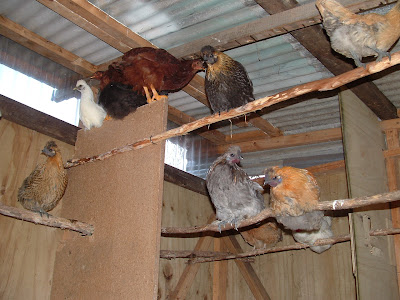
Some of my chickens in a house Steve built for them
But although I am not against meat-eating, I am wholly against factory farming, which is cruel. If we are to eat meat, the least we can do is ensure that the lives of the animals we benefit from are happy. Factory farming means high-density animal populations, and no animal will be happy living like that. Some 'free-range' farms house thousands of chickens in very large barns. In theory, the chickens are free range because they can go outside, but in practice very few do because that many chickens cannot get to the doors. For example, in theory, you can get 'out' when you are at a packed rock concert (the doors are not locked), but you only make the effort if you absolutely have to. Chickens are creatures of habit and if they are not trained to find the door, they'll stay put for good.
I am pleased to be a member of WSPA (World Society for the Protection of Animals). It may be run by vegans for all I know, but such things are never mentioned in its animal welfare work. The organisation sticks to its purpose of preventing animal cruelty and leaves people to run their own lives. But other animal advocacy groups, such as the New Zealand organisation SAFE (Save Animals from Exploitation), also promote veganism. SAFE's board members "Ideally ... will possess a compassionate attitude for all life, a personal commitment to improving the wellbeing of all animals, and an understanding and belief in a vegetarian/vegan lifestyle." I've also found that many people discussing animal welfare on the Internet are vegan.
For example, I took a look at a lecture by Gary Yourofsky, an animal rights activist in the States, in which he outlines the philosophy behind his veganism. He relies heavily on the religious principles that we should do unto others as we'd have them do to us and that we should not kill. He widens the usual interpretation of these principles by arguing that they apply to animals as well as to humans. Gary argues that, when we say we should treat 'others' as ourselves, 'others' means animals as well as humans. He puts animals and humans in the same category, in that animals share the physical capabilities of humans, such as sensory organs and a brain, and the ability to experience trauma and distress too. It is therefore not right to kill such creatures. He believes that treating animals differently to humans is like racism; he calls it speciesism. "The term is mostly used by animal rights advocates, who argue that it is irrational or morally wrong to regard sentient beings as objects or property." Wiki
I see two separate issues here, which vegans conflate: one is animals living free of cruelty, and the other is killing animals for meat. In Gary's lecture, he forces his audience to watch what goes on in a slaughter house. He really lays it on thick in order to get people to feel disgusted about eating meat. But all along I am thinking that he's merging the two issues into one. For him, cruelty is the same thing as killing. All the abuse of animals that goes on in factory farming is just a prelude to the killing end game. The unavoidable conclusion is that everyone who eats meat is responsible for the horrific abuse of factory farm animals. It isn't smart politics to alienate people like me who really care about animal welfare.
I see Gary's view as a product of modern Western society. The idea that the 'do not kill' principle applies to animals is very modern. I'm not familiar with Old Testament law, which is where the principle comes from, but I can't imagine anyone who lived a thousand years before Christ ever imagined it applied to animals. Unlike people back then, people today have a very uncomfortable relationship with death. We hide it away in hospitals, homes and slaughterhouses. I know from my experience how difficult it was to accept the (humane) killing of some of my roosters. But in the end, it was good to go through that process because I gained more appreciation of life and the reality of death as a defining moment within it. (The latest craze about planking, where guys lie down flat and balance in dangerous places like railings, is a good example of how death is unreal to young men.)
As I understand Baha'i law, cruelty to animals is forbidden but eating meat is permitted:
"Burden not an animal with more than it can bear. We, truly, have prohibited such treatment through a most binding interdiction in the Book. Be ye the embodiments of justice and fairness amidst all creation." Baha'u'llah: Kitab-i-Aqdas, page and para 87)Based on the above, I agree with much of what Gary Yourofsky says. Yes, we should treat animals with infinite kindness and yes, they do suffer under cruelty just as humans do.
"Briefly, it is not only their fellow human beings that the beloved of God must treat with mercy and compassion, rather must they show forth the utmost loving-kindness to every living creature. For in all physical respects, and where the animal spirit is concerned, the selfsame feelings are shared by animal and man. Man hath not grasped this truth, however, and he believeth that physical sensations are confined to human beings, wherefore is he unjust to the animals, and cruel." Selections ... `Abdu'l-Baha, pp 158-159)
"Say: O concourse of priests and monks! Eat ye of that which God hath made lawful unto you and do not shun meat. God hath, as a token of His grace, granted you leave to partake thereof save during a brief period [ie, the fast]. He, verily, is the Mighty, the Beneficent. Forsake all that ye possess and hold fast unto that which God hath purposed. This is that which profiteth you, if ye be of them that comprehend." Tablet to Napoleon III, in Summons para 154, p80
But is killing animals for food a form of cruelty? As I understand it, there is a fundamental difference between humans and animals. Humans have a soul, which means they are eternal life forms. When they die physically, they continue living in spiritual worlds forever. Animals do not have a soul. When they die physically, that is it for them. (Note though, that although animals do not have a soul, that does not mean they do not suffer under cruelty.)
The soul is also the vehicle behind our conscience and moral dimension. It's via the soul that a person has the ability to understand abstract concepts like justice, loving kindness and cruelty. Animals do not have a soul and therefore do not have the capacity to understand such concepts. They do not establish institutions to discuss the implications of these principles for the affairs of this world.
Animals, then, do not have a moral code that tells them not to be cruel to each other. My chickens will happily peck each other just to get an advantage over others. Little chicks are not protected, but picked on. As the farmer and the one with the moral code, it is me who interferes to ensure that the weakest in the flock get sufficient food and are protected. I think that, although humans and animals have much in common, we should avoid getting romantic about animals. We say they are innocent, but that is because they can't be held responsible if they are cruel. They don't know any better. They are not innocent because they are always kind. Animals kill each other for food, and always will. You can't tell an animal that this is cruelty. This shows that, despite shared sensory capacities, there is a fundamental difference between humans and animals.
Animals also do not understand the concepts of time - of past, present and future, and eternity. I noted someone saying that animals were eternal but humans not. But what is eternity to a creature that is created to be always in the present? A creature in the present is focused on whether life is good right now. If it is, all is well. They do not understand that they might be killed for food one day. They do not suffer weeks and years of terror in anticipation as a human would. Ideally, animals live very happy lives and then, maybe, one day, suffer a quick and painless death. That is that.

But although I am not against meat-eating, I am wholly against factory farming, which is cruel. If we are to eat meat, the least we can do is ensure that the lives of the animals we benefit from are happy. Factory farming means high-density animal populations, and no animal will be happy living like that. Some 'free-range' farms house thousands of chickens in very large barns. In theory, the chickens are free range because they can go outside, but in practice very few do because that many chickens cannot get to the doors. For example, in theory, you can get 'out' when you are at a packed rock concert (the doors are not locked), but you only make the effort if you absolutely have to. Chickens are creatures of habit and if they are not trained to find the door, they'll stay put for good.
Monday, 2 May 2011
Principles of pre-existence
The following is the beginning of my attempt to explain the ideas of pre-existence that Abdu'l-Baha discusses in chapter 80 of Some Answered Questions: "Real Pre-existence". It's not finished, but is enough to make a worthy blog entry. It is certainly meaty! Heaven knows, I saw stars trying to work it out.
Principles of pre-existence
Pre-existence of cause and time
Pre-existence refers to the idea of something existing before something else.
There are two ways to look at pre-existence:
- in terms of cause: A existed before B in that A caused B; for example, your mother came before you in that she gave birth to you.
- in terms of time: A existed before B because it preceded it in time; for example, the 19th century came before the 20th century.
Essential pre-existence and temporal pre-existence
Abdu'l-Baha divided pre-existence into two kinds: essential pre-existence and temporal pre-existence. These relate to the two ways of looking at pre-existence explained above. Essential pre-existence is to do with cause and temporal pre-existence is to do with time.
Essential pre-existence or pre-existence of essence
Abdu'l-Baha defines essential pre-existence as an existence that is not preceded by a cause.
The word 'essential' here is used in a philosophical way to mean a characteristic that is "guaranteed by the identity of the subject; necessary" (The Free Online Dictionary). In other words, an essential characteristic is a characteristic that is guaranteed to be a part of a thing's identity. For example, light and heat are essential attributes of the sun. If the sun did not give out light and heat, it would not be the sun.
If a thing is essentially pre-existent, this means that pre-existence is a necessary aspect of what that thing is. By definition, it 'pre-exists' or always already existed. It did not rely on anything else to bring it into being. It has no cause.
Temporal pre-existence or pre-existence of time
Abdu'l-Baha defines temporal pre-existence as an existence that is without a beginning.
A thing that is temporally pre-existent is a thing that has always existed, stretching back throughout all eternity.
Absolute and relative pre-existence
The concept of pre-existence can also be looked at in terms of absolute pre-existence and relative pre-existence.
Absolute pre-existence refers to the pre-existence of God. In philosophy, the idea of an absolute refers to the qualities of "perfection, completeness, universality, non-relativity, exemption from limitation or qualification, unconditionality". (Dagobert D. Runes, "Dictionary of Philosophy") Therefore, with absolute pre-existence, the quality of pre-existence is perfect, complete and without limitation. This is impossible for a created thing; it refers to God's pre-existence.
In contrast, relative pre-existence refers to pre-existence as between created things. The word 'relative' means "relational or pertaining to relations" (Dictionary of Philosophy). Therefore, relative pre-existence is about how created things are pre-existent in relation to each other.
For example, Abdu'l-Baha cites the example of the sun and its rays. The sun in relation to its rays is said to be an essential pre-existence. There is an unequal relationship between them: the rays are dependent on the sun for their existence, but the sun is independent, for it does not rely on its rays for its existence. The sun pre-exists, or always already exists, from the point of view of its rays.
But although the sun is said to be essentially pre-existent in relation to its rays, it is not in itself essentially pre-existent. It has a cause. It is not absolutely pre-existent, only relatively so.
Subscribe to:
Posts (Atom)